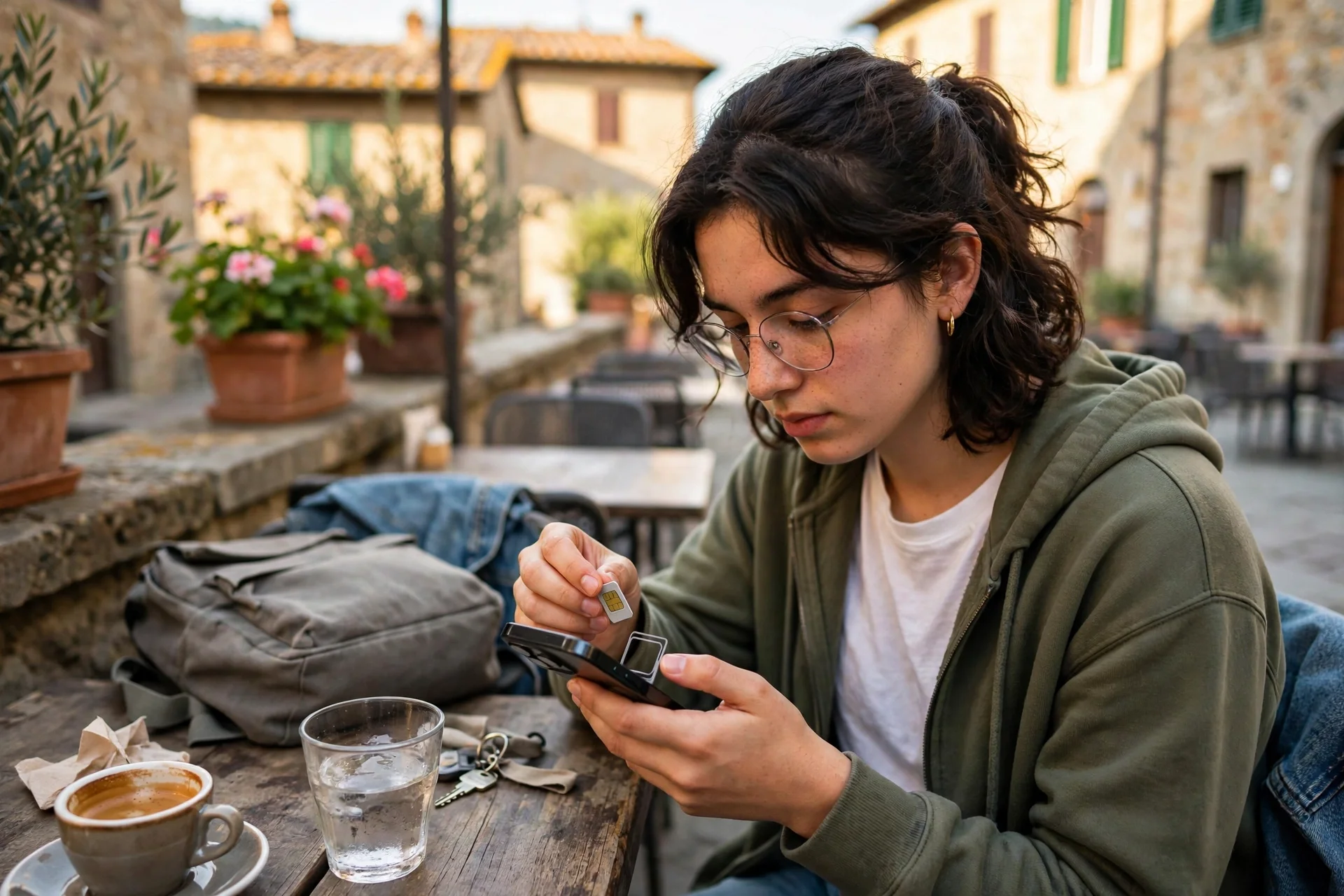
Land in Italy with a working phone and everything else gets easier: maps, bank verification codes, landlord messages, and your first video call home. Getting a SIM card in Italy as an international student is one of the smartest first-week errands, and it takes about twenty minutes. This 2026 guide covers the documents you need, prepaid versus contract options, and which operators give students the best deal.
SIM Card Italy 2026: Why You Need an Italian Number
You can survive a few days on roaming from home, but an Italian number quickly becomes essential. Banks send login codes by SMS, and many refuse foreign numbers. Landlords, university offices, and doctors' receptions all prefer to text a local number. Delivery apps, bike sharing, and transport tickets often require an Italian phone number to register. And roaming charges or fair-use limits from your home operator can quietly drain your budget over a semester.
An Italian SIM also unlocks better prices. Prepaid plans in Italy are famously cheap by European standards, with generous data allowances, and students can usually sign up with nothing more than a passport and a tax code. Get your number in week one and treat it as part of your arrival checklist, right next to housing and enrollment.
Documents You Need for a SIM Card in Italy
Italian law requires identity verification for every SIM, but the list is short. Bring a valid passport, your codice fiscale (the free Italian tax code every foreign resident can request), and ideally proof of your address in Italy, such as a rental contract or hospitality declaration. Some operators also accept a passport plus the tax code alone, especially for prepaid plans, but having an address document avoids a wasted trip.
If you do not have your codice fiscale yet, get it first: it takes minutes at the Agenzia delle Entrate office and you will need it for your bank account, health registration, and scholarship paperwork too. Non-EU students should also keep their residence permit or the postal receipt of their permit application handy, since some stores ask for it.
Prepaid vs Contract: Which Plan Fits a Student
Almost every international student should choose prepaid (ricaricabile). Prepaid plans have no credit checks, no long contracts, and no cancellation penalties: you pay monthly and stop whenever you leave. Contracts (abbonamento) can offer slightly better hardware deals, but they usually require an Italian bank account, a longer stay, and sometimes a deposit, so they make sense only if you are staying several years.
Compare plans on three numbers: gigabytes of data, minutes and SMS, and the monthly price. In 2026, typical student-friendly prepaid plans bundle 100 to 200 GB of data with unlimited calls for under 10 euros a month. Watch the fine print for EU roaming allowances, which matter if you plan weekend trips, and check whether 5G is included, since some budget plans still run on 4G only.
Main Operators and Student Deals in Italy
Italy has four network operators with their own infrastructure: TIM, Vodafone, WindTre, and Iliad, plus a crowd of virtual operators (ho. Mobile, Kena, Very Mobile, Fastweb) that rent network capacity and undercut the big names on price. For a student, the virtual operators are usually the sweet spot: plans from 5 to 8 euros a month with large data bundles and no frills.
Iliad built its reputation on transparent low pricing and is a favorite among international students. Ho. Mobile and Kena regularly run win-back offers that beat their standard prices. If you need the widest rural coverage for travel around Tuscany, TIM and Vodafone have the strongest networks outside the cities. Many operators also run back-to-school promotions in September and October, so if you arrive in autumn, compare the current offers before committing.
Portability is your friend: Italian number portability is free and takes one to two working days, so you can switch operators whenever a better deal appears and keep your number. Never feel locked in.
How to Get Your SIM: Step by Step
Getting connected is a simple afternoon errand. First, get your codice fiscale if you do not have one. Second, compare two or three current prepaid offers online, checking data, price, and EU roaming. Third, walk into an operator store or an authorized reseller with your passport, tax code, and address proof. Fourth, choose your plan, sign the short contract, and get the SIM activated on the spot; eSIM is available at most operators if your phone supports it.
Fifth, test everything before you leave the store: make a call, send a text, and load a webpage on mobile data. Sixth, download the operator's app and register your account so you can top up, check usage, and manage the plan without visiting a store. Keep the SIM packaging with the PIN and PUK codes somewhere safe; you will need the PUK if you ever mistype your PIN three times.
Costs, Coverage, and Common Mistakes
Budget 5 to 15 euros for the SIM and activation, plus the first month of your plan. Coverage in cities is excellent on all networks, with 5G widely available; rural valleys in Tuscany can be patchier, so check coverage maps if your housing is outside town. The classic mistakes are avoidable: do not buy a SIM at the airport without comparing prices in town, do not sign a contract when prepaid fits your stay, and do not forget to update your number with your bank, your university, and your landlord.
One more practical tip: keep your home SIM active for the first month in a dual-SIM phone or a second device. Verification codes from your home bank and two-factor logins often still go to your old number during the transition, and keeping both numbers alive prevents lockouts at the worst moment.
Staying Connected on a Student Budget
Once your Italian number is live, a few habits keep costs minimal. Use Wi-Fi at the university and your housing for heavy downloads and video calls, and let mobile data cover the day. Most operators let you change plans from the app in minutes, so start with a mid-size bundle and adjust after your first month of real usage. If you travel home often, pick a plan with generous EU roaming data so your Italian SIM keeps working across borders.
Your phone is the key to everything else in your student life. With a local number in place, setting up your application paperwork, receiving scholarship notifications, and coordinating with classmates all get simpler. And while you are sorting the practical side, the university canteens in Tuscany and affordable student housing in Tuscany are the other two budget levers worth pulling in your first weeks.
A SIM card in Italy is cheap, fast to get, and unlocks the practical side of student life. Bring your passport and tax code, compare the prepaid offers, and get connected in your first week. It is a small errand with an outsized payoff: every bank code, map search, and message home will just work. If your move to Italy is still in the planning stage, you can apply to study at Universita Verde di Toscana and add this guide to your arrival checklist.