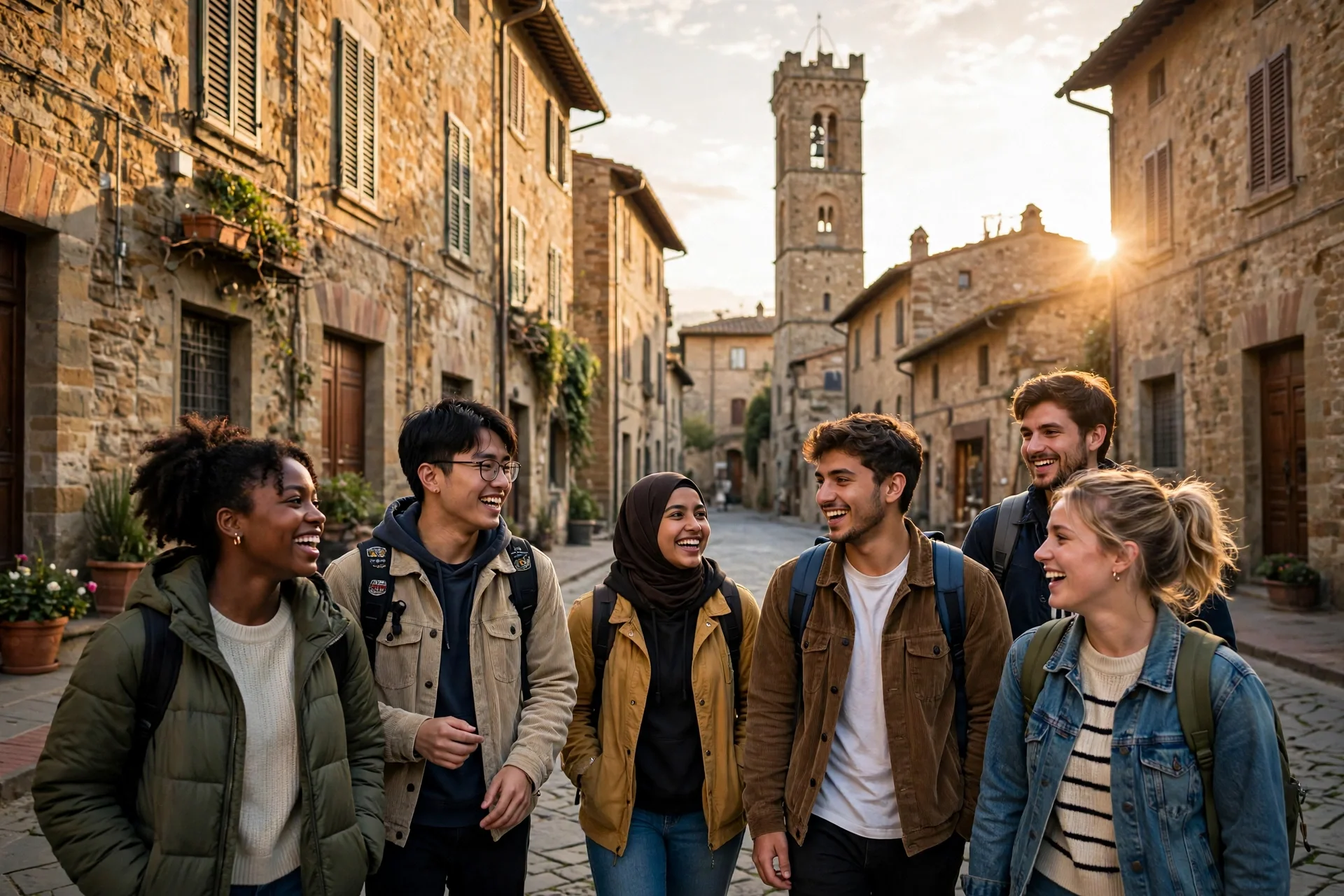
Every year, tens of thousands of European students pack a suitcase and spend a semester studying in another country. If your plan is Erasmus Italy 2026, Tuscany deserves a serious look. Beyond the postcard landscapes, the region combines affordable student cities, universities with growing English-taught course catalogs, and a quality of life that turns one exchange semester into the story you will tell for years. This guide explains how the Erasmus+ program works in Italy, who can apply, what the funding covers, and how to organize an exchange semester in Tuscany, from housing in Arezzo to the paperwork you need before departure.
Erasmus Italy 2026: Who Can Apply
Erasmus+ is the European Union's program for learning mobility, and the classic "Erasmus semester" remains its best known action. To take part, you must be enrolled at a higher education institution that holds the Erasmus Charter for Higher Education, which covers most European universities. Bachelor students can usually apply from their second year onward, while master and doctoral students are eligible throughout their studies.
The key condition is the inter-institutional agreement: your home university must have a signed exchange agreement with the university you want to attend in Italy, covering your field of study. Selection is managed by your home university, not by the host. Committees typically weigh academic merit, your motivation letter, and proof of language proficiency for the language of instruction. Competition for popular destinations is real, so a strong application and a flexible list of preferred universities improve your odds.
Application Deadlines You Cannot Miss
Erasmus calls for the 2026/2027 academic year generally open in autumn or winter 2025, and each university sets its own internal deadlines. These dates are strict: missing your home university's deadline means waiting a full year. Language certificates such as IELTS or institutional tests take weeks to arrange, so start the paperwork as soon as the call is announced, not when it closes.
How Erasmus Funding Works
The Erasmus grant is designed as a contribution to the higher cost of living abroad, not as a full scholarship, so plan your budget accordingly. The monthly amount depends on the country group of your destination: Italy sits in the middle group, which means a solid monthly contribution that stretches further in smaller Tuscan cities than in Milan or Rome.
Students with fewer opportunities can receive a monthly top-up, and there is an extra allowance for those who choose low-emission travel to reach their destination. One of the best features of the program is financial: you continue paying any tuition to your home university and pay zero tuition fees to the host university in Italy. Exact grant figures are updated every academic year, so confirm the current amounts with your Erasmus coordinator before you sign anything.
Why Tuscany Wins for Exchange Students
Tuscany offers the classic Italian experience without the price tag of the big metropolitan hubs. Cities like Arezzo are built on a student scale: walkable historic centers, rents far below Milan or Florence, lively squares full of bars where an aperitivo costs half what you would pay elsewhere, and train stations that put Florence, Siena, Rome and the coast within easy weekend reach.
For exchange students, the size of the city matters more than most people expect. In a mid-sized Tuscan city you will actually get to know people: classmates, flatmates, baristas, the local Erasmus Student Network section. That social density is what turns an exchange from a line on your CV into a second home. When you start planning, read our guide to finding student housing in Arezzo so you know which neighborhoods suit student budgets and how far in advance to search.
Choosing Courses and the Learning Agreement
European universities use the ECTS credit system, which makes recognizing your semester abroad straightforward. Before departure, you agree on your courses with your home university through the Learning Agreement, a document signed by you, your home coordinator, and the host university. A full semester usually means 30 ECTS.
Check the host university's course catalog early and verify which courses are actually taught in English, since catalogs sometimes list courses that run in Italian only. If a course is full or clashes with your timetable after arrival, you can modify the Learning Agreement during the first weeks of the semester: this is normal, but keep your home coordinator in the loop so your credits are recognized when you return.
Paperwork: Visa, Health Insurance and Arrival
If you are an EU or EEA citizen, you need no visa for your exchange in Italy. Non-EU students studying in Europe on exchange should check carefully: depending on your nationality, your residence status, and the length of the stay, you may need an Italian study visa, and consulate appointments fill up fast. Our Italian student visa step-by-step guide walks through the documents consulates usually request.
On health coverage, EU students should carry the European Health Insurance Card, while non-EU students need private health insurance valid for the whole stay. Once in Italy, getting a codice fiscale (tax code) is a smart early move: you will need it for a phone contract, a bank account, and sometimes for the rental agreement itself.
Settling In: Housing and Daily Life
Housing is the one thing you should never leave to the last minute. University residences offer the simplest landing, but places are limited; the private market of shared flats is the most common solution in cities like Arezzo. Start searching at least two months before arrival, join the local student housing groups, and treat any offer that looks too good to be true with suspicion: never wire a deposit without a signed contract or a verified landlord.
Daily life in Tuscany rewards simple habits. Cooking with market produce keeps costs low, the university mensa offers full meals at student prices, and regional trains are cheap if you book ahead. Even a basic level of Italian transforms the experience, from dealing with landlords to being invited to dinner by Italian classmates: a short intensive course before departure pays for itself in friendships.
From Exchange to a Full Degree in Tuscany
Many Erasmus students arrive for one semester and start wondering how to stay longer. If Tuscany wins you over, you already know the strongest argument for returning: you have lived the student life here, not just visited it. A full degree means deeper language skills, a local network, and access to regional funding such as the DSU Toscana scholarship, which can cover up to 100 percent of costs for eligible students.
If that idea appeals to you, you can apply for a full degree at UVT through the online application portal. The admission team reviews applications on a rolling basis, and applying early gives you more time to arrange a visa, funding, and housing for the full academic year. One semester abroad might just be the beginning.