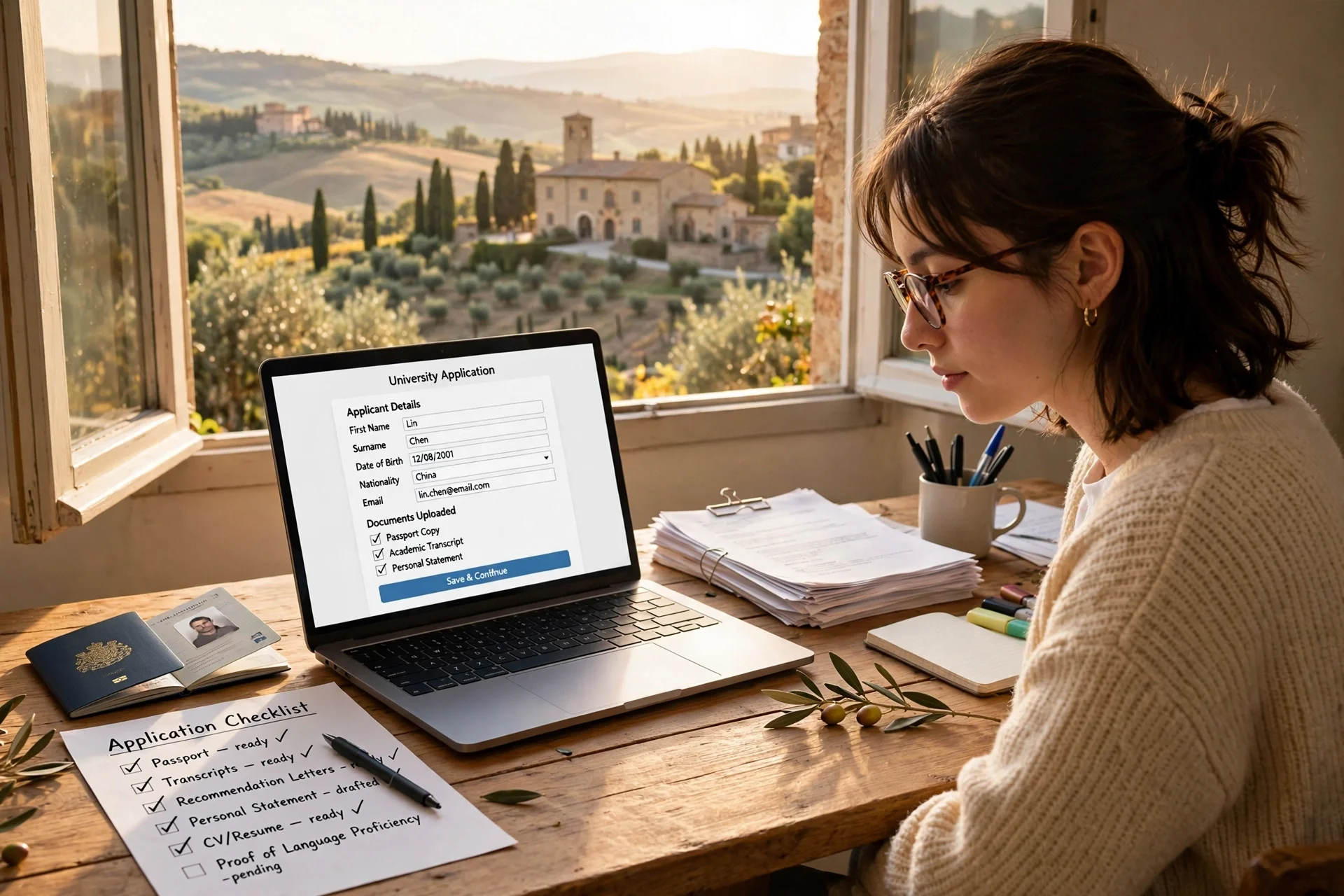
Learning how to apply to university in Italy is the first real step toward an Italian degree, and for international students the process is more straightforward than it looks. Italy offers low tuition, English-taught programs, generous regional scholarships and a student lifestyle that is hard to beat. Whether you are finishing high school or planning a master's degree, this guide walks you through every stage of the application, from choosing a program to landing in Tuscany with your student visa in hand.
Why Apply to University in Italy in 2026
Italy combines academic tradition with surprising affordability. Tuition at Italian universities is a fraction of what students pay in the United States or the United Kingdom, and regional funding such as the DSU Toscana scholarship can cover up to 100% of costs, including housing and meals. Many degree programs are taught entirely in English, so you do not need to speak Italian to begin your studies.
Beyond the numbers, studying in Italy means living in a country where history, food, art and community are part of everyday life. Cities like Arezzo offer a safe, walkable, student-friendly environment with quick rail connections to Florence and Rome. For the 2026 intake, universities are expanding English-taught tracks and digital application systems, which makes this one of the easiest years yet to apply from abroad.
Step 1: Choose Your Program and Check Requirements
Before you apply to university in Italy, decide which degree level and field fit your goals. Italian universities follow the Bologna Process, so degrees are recognized across Europe and beyond.
Bachelor's degrees (Laurea Triennale)
Three-year undergraduate programs require a secondary school diploma that qualifies you for university admission in your home country. Some programs are open access, while others have limited places and an entrance test. Check whether your chosen program is taught in English or Italian and note the language certificate required, usually IELTS 5.5 to 6.5 or a B2 level for English-taught tracks.
Master's degrees (Laurea Magistrale)
Two-year graduate programs require a bachelor's degree in a related field, typically with a minimum number of credits in relevant subjects. Most master's programs at internationally oriented universities are taught in English. Some competitive programs ask for a CV, a motivation letter and sometimes an online interview.
Professional and single-cycle programs
Fields such as architecture can follow a five-year single-cycle structure. Admission often involves a portfolio or aptitude test, so start preparing these materials months in advance.
Step 2: Prepare Your Documents Checklist
Missing paperwork is the most common reason applications get delayed. Gather these documents early, since translations and legalizations take time.
- Valid passport with an expiration date well beyond your planned stay.
- Secondary school diploma or bachelor's degree certificate, plus official transcripts of records.
- Certified translations into Italian or English, where required, and legalization or apostille of your diplomas.
- Proof of language proficiency: IELTS, TOEFL or equivalent for English-taught programs.
- Motivation letter or statement of purpose explaining why you chose the program.
- Curriculum vitae in European format for master's applications.
- One or two letters of recommendation from teachers or professors.
- Passport-style photographs, as specified by the university.
Start this step at least three to four months before the application deadline. If your documents need an apostille or consular legalization, that process alone can take several weeks.
Step 3: Submit Your Application Online
Most Italian universities now run fully online application portals. To apply to university in Italy through the Università Verde di Toscana, you complete the process on the uvt-edu.it/apply portal: create an account, select your program, upload your documents and submit before the deadline.
Take the application form seriously. Double-check that names match your passport exactly, that every file is legible, and that you have answered every required field. After submission you will receive a confirmation email; keep it, because it contains your application reference number. Admissions teams review applications on a rolling basis for many programs, so applying early improves your chances and gives you more time for the visa stage.
Step 4: Secure Your Funding and Scholarships
Do not wait for admission results to think about money. The most generous funding for students in Tuscany is the regional DSU Toscana scholarship, which for eligible students covers up to 100% of tuition plus free accommodation, dining hall meals and an annual living stipend. DSU calls follow their own calendar with strict deadlines, so prepare your financial documents in parallel with your application.
Read our DSU Toscana scholarship guide 2026 for the full list of requirements, income thresholds and application dates. International students are eligible, and the application is submitted online through the regional student services portal.
Step 5: Get Your Student Visa
If you are a non-EU citizen, you need a student visa before traveling to Italy. Once you receive your admission letter, book an appointment at the Italian consulate in your country and prepare your visa file: admission letter, proof of accommodation, proof of financial means, health insurance and a valid passport.
Our step-by-step guide to the student visa for Italy explains each document, typical processing times and practical tips to get approved on the first attempt. Start the visa process the moment you are admitted, because consulate appointments fill up fast in summer.
Common Mistakes When You Apply to University in Italy
Even strong candidates stumble on avoidable errors. Watch out for these.
First, missing the pre-enrollment window. Non-EU students often need to pre-enroll through the Universitaly portal within a fixed window; missing it can cost you the entire intake. Second, submitting untranslated or non-legalized diplomas, which forces the admissions office to pause your file. Third, underestimating language requirements: even if your program is in English, daily life and internships are easier with basic Italian, and some programs test it.
Fourth, applying for scholarships too late. Funding deadlines rarely match admission deadlines, so track both calendars from the start. Fifth, leaving the visa to the last minute. A delayed visa means a delayed arrival, and some universities have limited flexibility on enrollment dates.
Your 2026 Application Timeline
Here is a practical schedule if you are aiming for the Fall 2026 intake.
From October to December 2025, research programs and confirm entry requirements. From January to March 2026, prepare and legalize documents, take your language test and draft your motivation letter. From March to May 2026, submit your online application and apply for the DSU scholarship in parallel. From June to August 2026, complete your student visa process, arrange housing in Arezzo and book your travel. In September 2026, arrive, enroll and begin orientation.
Adjust these windows to your published deadlines, which always take priority over any general timeline.
Start Your Application for 2026 Today
Now that you know how to apply to university in Italy, the only step left is to begin. Choose a program that matches your ambitions, gather your documents early, and submit through the uvt-edu.it/apply portal before the deadline. With affordable tuition, English-taught degrees, DSU scholarships up to 100% and the beauty of Tuscany waiting, 2026 could be the year your Italian academic journey begins.